
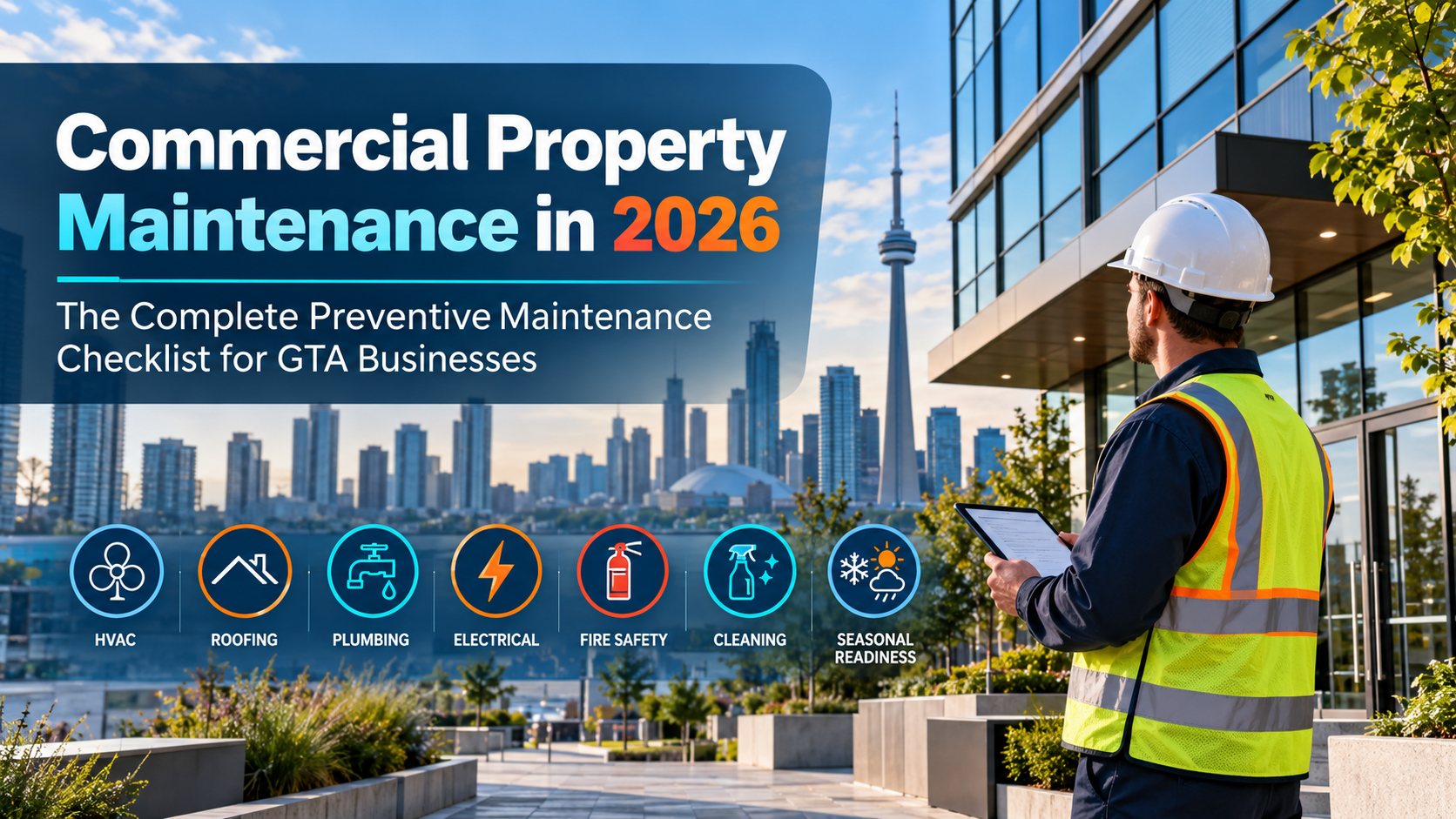
Commercial property maintenance in 2026 is about more than fixing broken equipment or responding to tenant complaints. It involves regularly inspecting, servicing, and protecting commercial buildings to prevent costly repairs, improve safety, and keep business operations running smoothly.
For businesses across the Greater Toronto Area (GTA), a preventive maintenance plan is especially important because buildings must withstand freezing winters, snow accumulation, spring thaws, summer humidity, and changing occupancy demands.
Whether you manage an office building, retail plaza, industrial facility, or commercial rental property, this complete commercial property maintenance checklist will help you identify potential problems early and maintain your property throughout the year.
What Is Commercial Property Maintenance?
Commercial property maintenance is the ongoing process of inspecting, cleaning, repairing, and servicing a commercial building and its essential systems. Its purpose is to keep the property safe, functional, energy-efficient, and suitable for employees, customers, tenants, and visitors.
Typical commercial building maintenance tasks include:
- Inspecting HVAC systems, plumbing, electrical equipment, and lighting.
- Maintaining roofs, gutters, exterior walls, windows, and parking areas.
- Checking fire protection systems and emergency exits.
- Cleaning common areas and addressing sanitation issues.
- Preventing water damage, pest infestations, and equipment failures.
- Maintaining records of inspections, repairs, and scheduled services.
A proactive maintenance strategy helps property owners avoid unexpected breakdowns and make better decisions about long-term building expenses.
Why Is Preventive Maintenance Important for GTA Businesses in 2026?
Preventive maintenance helps GTA businesses reduce avoidable repair costs, minimize operational disruptions, and protect their commercial properties against seasonal damage.
Toronto and surrounding communities experience demanding weather conditions that can accelerate building deterioration. Snow, ice, freezing temperatures, rain, and temperature fluctuations can affect roofs, exterior surfaces, drainage systems, and mechanical equipment.
Here are five important benefits of preventive maintenance.
- Prevents Expensive Emergency Repairs
Small building issues can become major problems when ignored. A minor roof leak, for example, may eventually damage insulation, ceiling tiles, electrical components, and interior finishes.
Regular inspections help identify these issues before they require extensive repairs.
- Improves Tenant and Employee Safety
Poor lighting, slippery walkways, blocked exits, and damaged flooring can create safety risks. Routine inspections help property managers identify hazards and arrange timely corrective action.
- Extends Equipment Lifespan
HVAC systems, pumps, elevators, and other mechanical equipment perform more reliably when maintained according to manufacturer recommendations and applicable service requirements.
- Supports Energy Efficiency
Dirty filters, poorly maintained equipment, failing seals, and incorrect control settings can contribute to unnecessary energy consumption.
Maintenance helps identify opportunities to improve building performance without immediately replacing expensive equipment.
- Protects Property Value
A well-maintained building is easier to manage, more attractive to prospective tenants, and less likely to develop preventable deterioration that affects its long-term value.
The Complete Commercial Property Maintenance Checklist for 2026
A preventive maintenance checklist organizes inspections and servicing into manageable tasks. The following checklist covers the main areas that GTA property owners and facility managers should review throughout the year.
- HVAC System Maintenance Checklist
HVAC maintenance is essential for maintaining comfortable indoor temperatures, reliable ventilation, and appropriate indoor air quality.
Commercial HVAC systems often experience increased demand during Toronto’s cold winters and hot summers.
HVAC preventive maintenance checklist:
- Inspect and replace air filters according to manufacturer recommendations and operating conditions.
- Check thermostats, sensors, and building automation controls.
- Inspect heating and cooling equipment for unusual noise, vibration, or leakage.
- Clean coils and inspect condensate drains where applicable.
- Check ventilation equipment and accessible ductwork for problems.
- Inspect belts, motors, and electrical connections as appropriate.
- Schedule professional servicing before peak heating and cooling seasons.
- Record recurring faults and equipment performance issues.
Real-life example: Imagine an office building in Mississauga whose heating system stops working during a January cold spell. If the building manager had arranged a pre-winter inspection, a deteriorating component might have been identified and repaired before the coldest weather arrived.
The lesson is simple: scheduled HVAC maintenance can reduce the risk of disruptive failures when occupants need the system most.
- Roof, Gutter, and Drainage Maintenance Checklist
Roof and drainage maintenance helps prevent leaks, water infiltration, structural deterioration, and interior damage.
Commercial properties should receive regular roof inspections appropriate to their roofing system, building condition, and exposure to severe weather.
Roof and drainage checklist:
- Inspect visible roofing surfaces for deterioration, punctures, or damaged seams.
- Check flashing around roof penetrations and other vulnerable areas.
- Remove debris from gutters, roof drains, and accessible drainage points.
- Inspect downspouts and confirm that water drains away from the building.
- Look for signs of interior water staining or ceiling damage.
- Review roof condition after significant storms when safe access is available.
- Arrange professional assessment of suspected leaks or membrane damage.
- Check that snow and ice management procedures are in place before winter.
Roof work must be performed safely by qualified personnel. Snow removal, in particular, should follow a site-specific plan rather than relying on untrained staff to access the roof.
- Plumbing and Water Damage Prevention Checklist
Plumbing maintenance helps prevent leaks, water waste, unpleasant odours, and costly damage to walls, floors, ceilings, and equipment.
Commercial buildings should pay particular attention to pipes in unheated spaces, older plumbing connections, and areas with a history of moisture problems.
Plumbing checklist:
- Inspect accessible pipes, valves, and connections for leaks or corrosion.
- Check washrooms, kitchens, and utility rooms for dripping fixtures.
- Monitor water bills for unexplained increases in consumption.
- Inspect floor drains and accessible drainage points.
- Check pumps and other water-related equipment according to service requirements.
- Look for damp patches, mould-like growth, and persistent musty odours.
- Protect vulnerable plumbing against freezing temperatures.
- Confirm that occupants know how to report leaks promptly.
If a leak is discovered near electrical equipment, restrict access and arrange appropriate professional assistance. Water-related electrical hazards should never be treated as routine cleaning issues.
- Electrical and Lighting Maintenance Checklist
Electrical maintenance helps reduce the risk of equipment failure, unsafe conditions, and unnecessary interruptions to business operations.
Electrical inspections and repairs should be completed by appropriately qualified professionals.
Electrical maintenance checklist:
- Inspect accessible areas for damaged outlets, covers, and visible wiring concerns.
- Check interior and exterior lighting.
- Test emergency lighting and exit signs according to applicable requirements.
- Investigate repeatedly tripping breakers or unexplained power interruptions.
- Inspect electrical panels through qualified personnel.
- Review backup power equipment and emergency systems according to manufacturer guidance.
- Confirm that electrical rooms remain accessible and free of inappropriate storage.
- Document faults and completed repairs.
Repeated breaker trips, burning smells, unusual heat, or buzzing electrical equipment should be investigated promptly rather than repeatedly reset or ignored.
- Fire Safety and Emergency Preparedness Checklist
Fire safety maintenance helps ensure that occupants can respond appropriately to emergencies and that essential protective systems remain functional.
The precise inspection, testing, and documentation requirements depend on the building, its equipment, applicable Ontario requirements, and any relevant municipal rules.
Fire safety checklist:
- Keep emergency exits and escape routes clear.
- Check that fire doors close and latch properly.
- Arrange required inspection and servicing of fire alarms and sprinkler systems.
- Check portable fire extinguishers according to applicable requirements.
- Ensure fire safety plans and emergency contact information are accessible.
- Confirm that required inspections and maintenance records are current.
- Check emergency lighting and exit signage.
- Review evacuation procedures with relevant staff and occupants.
Never disable a fire protection system without following the required procedures. Where a system is impaired, arrange the appropriate corrective action and any required temporary safeguards.
- Exterior, Parking Lot, and Walkway Maintenance Checklist
Exterior maintenance protects visitors, employees, tenants, and delivery personnel while preserving the appearance and usability of the property.
Exterior maintenance checklist:
- Inspect parking areas for potholes, cracks, and deteriorating pavement.
- Check sidewalks, ramps, and entrances for trip hazards.
- Inspect handrails, exterior stairs, and accessible routes.
- Check exterior lighting and visible signage.
- Inspect building façades for loose materials or visible deterioration.
- Remove litter and maintain landscaping.
- Check catch basins and drainage areas for blockages.
- Establish snow-clearing and ice-control procedures before winter weather begins.
For GTA commercial properties, winter maintenance deserves special attention. Snow piles, refreezing meltwater, and icy entranceways can create hazards even after the main snowfall has ended.
- Interior, Washroom, and Common-Area Maintenance Checklist
Clean, functional interior spaces support employee productivity, customer confidence, and tenant satisfaction.
Interior maintenance checklist:
- Inspect floors, ceilings, walls, and doors for damage.
- Repair loose flooring and address trip hazards.
- Check washroom fixtures, taps, toilets, and dispensers.
- Maintain appropriate cleaning schedules for high-traffic areas.
- Inspect windows, door seals, and weatherstripping.
- Check for signs of moisture, condensation, or persistent odours.
- Confirm that storage areas remain organized and accessible.
- Respond to tenant complaints and maintenance requests promptly.
A small issue, such as a loose entrance tile, may seem unimportant until someone trips over it. Routine walkthroughs help property managers identify these hazards before an incident occurs.
- Pest Control and Indoor Air Quality Checklist
Pest prevention and indoor air quality management help maintain a healthier, more comfortable commercial environment. Moisture, food waste, poor ventilation, and unsealed entry points can contribute to recurring building problems.
Maintenance tasks include:
- Inspect waste storage areas and arrange regular waste removal.
- Check for pest activity near entrances, loading docks, and utility spaces.
- Seal suitable gaps around doors, windows, and service penetrations.
- Investigate persistent condensation and musty odours.
- Keep ventilation openings clear and accessible.
- Schedule professional pest control when necessary.
Addressing moisture sources is particularly important because simply treating visible mould-like growth may not resolve the underlying problem.
How Often Should Commercial Property Maintenance Be Performed?
The frequency of commercial property maintenance depends on the building’s age, occupancy, equipment, condition, and operating environment. A practical maintenance calendar separates routine checks from seasonal inspections and specialized servicing.
| Frequency | Recommended maintenance activities |
| Daily | Check entrances, visible hazards, washrooms, and urgent maintenance reports. |
| Weekly | Inspect common areas, lighting, accessible plumbing, and exterior cleanliness. |
| Monthly | Review maintenance requests, inspect accessible building components, and check scheduled service records. |
| Quarterly | Review HVAC performance, drainage, recurring defects, and relevant equipment service requirements. |
| Spring and fall | Prepare the building for seasonal weather, inspect roofing and drainage, and service heating or cooling equipment as appropriate. |
| Annually | Review the maintenance plan, asset condition, long-term repair priorities, and applicable inspection records. |
This schedule is a planning guide, not a substitute for legally required inspection intervals or manufacturer instructions. Fire protection systems, elevators, and other regulated equipment may require different schedules.
Preventive Maintenance vs. Reactive Maintenance: Which Is Better?
Preventive maintenance and reactive maintenance serve different purposes, but preventive maintenance is generally the stronger foundation for managing commercial buildings.
| Factor | Preventive maintenance | Reactive maintenance |
| Approach | Identifies and addresses problems before failure | Responds after a problem occurs |
| Cost planning | Easier to schedule and budget | Costs can be unpredictable |
| Business disruption | Helps reduce unexpected downtime | May interrupt normal operations |
| Equipment lifespan | Supports appropriate equipment care | Delayed repairs can contribute to deterioration |
| Best use | Routine inspections and scheduled servicing | Unexpected breakdowns and urgent repairs |
Which approach should GTA businesses choose? Use preventive maintenance for routine building care and keep reactive maintenance procedures available for unexpected problems. A reliable strategy combines both rather than assuming every failure can be prevented.
How to Build a Commercial Property Maintenance Plan in 2026
A useful maintenance plan assigns responsibility, establishes service schedules, and tracks the condition of important building assets.
Follow these five steps:
- Inspect the property. Identify the building’s major systems, visible defects, safety concerns, and recurring maintenance issues.
- Prioritize risks. Address life-safety hazards, active leaks, electrical concerns, and critical equipment failures before cosmetic improvements.
- Create a maintenance calendar. Schedule inspections and servicing around seasonal demands, operating hours, and equipment requirements.
- Assign responsibilities. Decide which tasks employees can perform safely and which require qualified technicians or specialist contractors.
- Track results. Maintain records of completed work, outstanding repairs, expenses, and recurring problems.
For example, a commercial property manager in Brampton might discover that water repeatedly collects near a loading dock after heavy rain. Rather than arranging repeated cleanup, the manager could investigate drainage, correct the underlying issue, and schedule follow-up inspections.
That approach addresses the cause of the problem instead of repeatedly paying to manage its symptoms.
Should You Hire Professional Facility Maintenance Services?
Professional facility maintenance services can help businesses manage complex building systems, specialized repairs, scheduled inspections, and recurring maintenance responsibilities.
Professional support is particularly valuable when a property has multiple tenants, aging equipment, extensive mechanical systems, or limited in-house maintenance staff.
Consider hiring a qualified maintenance provider if:
- Building issues repeatedly disrupt business operations.
- Maintenance requests are becoming difficult to track.
- Your property needs specialized technical servicing.
- Seasonal preparation is inconsistent or frequently delayed.
- You need clearer maintenance records and budgeting.
- Your team cannot safely perform certain inspections or repairs.
When comparing providers, review their experience with similar properties, service scope, emergency response arrangements, insurance, qualifications, reporting practices, and pricing.
Property maintenance Toronto businesses require may differ significantly depending on whether they operate a small retail unit, a multi-storey office building, or an industrial warehouse. Choose services that match the actual building and its risks.
What Should a Commercial Property Maintenance Budget Include?
A commercial maintenance budget should account for routine servicing, inspections, repairs, seasonal preparation, emergency response, and longer-term asset replacement.
Include the following categories:
- Planned HVAC and mechanical servicing.
- Plumbing and electrical maintenance.
- Roof, façade, and drainage repairs.
- Landscaping, snow removal, and ice control.
- Cleaning, pest prevention, and waste management.
- Fire safety and other required inspections.
- Emergency repair allowances.
- Capital planning for aging building systems.
Avoid relying on a single universal maintenance cost per square foot. Actual costs depend on building size, age, condition, equipment, service frequency, occupancy, and local contractor rates.
Review historical maintenance spending alongside outstanding repairs. A building with low routine spending but frequent emergencies may need a more effective maintenance strategy rather than simply a larger emergency budget.
2026 Compliance Reminder for Ontario Commercial Properties
Commercial property owners and managers should confirm that maintenance procedures meet the requirements applicable to their building, equipment, and occupancy.
Ontario’s Fire Code addresses inspection, testing, maintenance, and recordkeeping for relevant fire protection and life-safety systems. The applicable requirements and intervals depend on the system and circumstances. Ontario also provides guidance on snow loading and roof failures, including the need for safe snow removal procedures when excessive loading or structural distress is a concern.
These resources are useful starting points, but a general checklist cannot replace a building-specific compliance review.
Final Thoughts: Make Preventive Maintenance a Business Priority
Commercial property maintenance is an investment in building reliability, occupant safety, and long-term asset performance. For GTA businesses, a structured preventive maintenance checklist helps address seasonal risks, identify defects early, and reduce avoidable operational disruptions.
Start with a property inspection, establish a realistic maintenance calendar, document completed work, and prioritize problems according to risk. Where specialized expertise is needed, engage qualified professionals.
The most effective maintenance plan is not necessarily the most complicated. It is the one your team follows consistently, reviews regularly, and adapts as your building’s needs change.
Frequently Asked Questions
Why is preventive maintenance important for commercial buildings in the GTA?
Preventive maintenance helps GTA businesses identify building problems before they cause costly repairs or operational disruptions. Regular inspections also help properties prepare for Toronto’s freezing winters, snow accumulation, heavy rainfall, and summer heat.
What should a commercial property maintenance checklist include?
A commercial property maintenance checklist should include:
- HVAC system inspections and servicing
- Roof, gutter, and drainage inspections
- Plumbing and electrical checks
- Fire protection and emergency exit inspections
- Parking lot, sidewalk, and exterior maintenance
- Interior cleaning and common-area inspections
- Pest prevention and moisture control
- Seasonal maintenance and repair records
The checklist should be adjusted to the building’s age, equipment, occupancy, and applicable safety requirements.
How often should commercial property maintenance be performed?
Commercial property maintenance should be performed according to a planned schedule. Daily or weekly walkthroughs can identify visible hazards, while monthly inspections help track recurring issues. Seasonal inspections prepare buildings for changing weather, and specialized equipment should be serviced according to manufacturer recommendations and applicable regulations.
What are the benefits of hiring professional facility maintenance services?
Professional facility maintenance services help businesses manage building inspections, equipment servicing, repairs, and seasonal maintenance. Qualified providers can help identify potential problems, maintain service records, coordinate specialist contractors, and reduce the burden on in-house teams.
How much does commercial property maintenance cost in Toronto?
Commercial property maintenance costs in Toronto depend on building size, age, condition, equipment, service frequency, and the scope of work. Routine inspections and scheduled servicing generally have more predictable costs than emergency repairs. Businesses should request a property-specific quote rather than rely on a universal price estimate.
What is the difference between preventive and reactive property maintenance?
Preventive maintenance involves inspecting and servicing building systems before failures occur. Reactive maintenance involves repairing problems after they develop. Preventive maintenance supports better planning and may reduce unexpected downtime, while reactive maintenance remains necessary for emergencies and unforeseen breakdowns.

